The Digital Revolution: A Guide to Free-Form Lens Technology
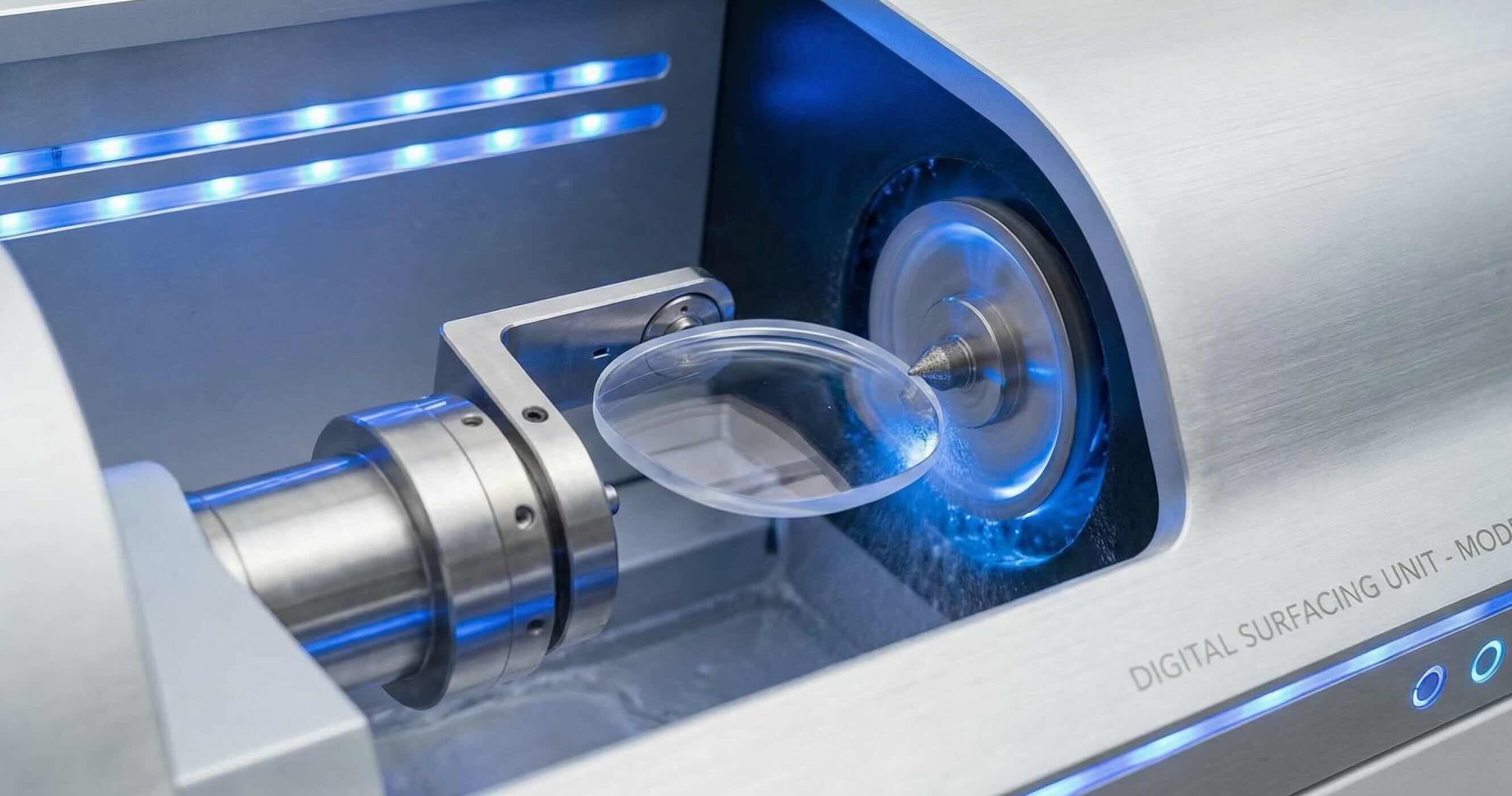
The days of "off-the-shelf" semi-finished lens blanks are quickly fading. Digital surfacing, also known as free-form technology, has fundamentally changed how light is managed as it passes through corrective lenses. For those looking to map out their future in this evolving industry, you can explore detailed career paths to see how technical specializations like digital lab management are growing.
1. Manufacturing: From Molding to Sculpting
To understand the future, we must look at the past. Traditional lenses were manufactured using "molds" that created fixed optical designs. The lab would then use large grinding tools to cut the prescription onto the back of the lens.
The Free-Form Difference
Free-form technology uses a single-point diamond-tipped cutting tool that is controlled by sophisticated computer software. Instead of grinding a general shape, the machine "sculpts" the prescription onto the back surface of the lens with a precision of 0.01 diopters, six times more accurate than traditional methods.
Point-by-point customization across the entire lens surface.
Elimination of peripheral distortion found in traditional progressives.
2. Wavefront Analysis & HD Vision
Digital technology allows for "High-Definition" vision by addressing **Higher-Order Aberrations (HOAs)**. Traditional lenses only correct for sphere, cylinder, and axis. Digital designs can compensate for the microscopic imperfections in the patient's eye and the unique way they look through different parts of the lens.
Expanded Field
Up to 30% wider field of vision in progressive lenses.
Sharper Contrast
Improved night vision and reduced glare from digital screens.
Reduced 'Swim'
Minimized peripheral distortion for easier adaptation.
3. Position of Wear: The New Measurement Standard
A digital lens is only as good as the measurements provided by the optician. To truly "tailor" the lens, three critical **Position of Wear (POW)** measurements are required:
Vertex Distance
The distance from the back of the lens to the front of the cornea. If a frame sits too close or too far, the effective power of the prescription changes. Digital lenses recalculate the power based on this specific distance.
Pantoscopic Tilt
The angle at which the frame front leans toward the cheeks. Proper tilt ensures the visual axis of the eye aligns with the optical center of the lens, reducing unwanted prism.
Wrap Angle
Also known as "face form." This measures how the frame curves across the face. For wrap-around sunglasses or high-base-curve frames, digital compensation is mandatory to prevent peripheral distortion.
4. The Optician's Evolving Role
With the rise of automation, some worry the optician's role is shrinking. In reality, digital technology makes the optician **more critical than ever**. High-tech lenses require high-touch measurements and expert troubleshooting.
Pro Troubleshooting Tip
"If a patient complains of a 'narrow' corridor in their new digital progressives, check the Pantoscopic Tilt first. Even a 2-degree error in tilt can significantly reduce the effective width of the reading zone in a free-form design."
Mastering the Tech
Digital lens technology is no longer a luxury feature. It is the industry standard. As an optician, staying current with these advancements through ABO-approved continuing education is essential for career longevity and patient satisfaction.